


One of the country’s most controversial judges is an adviser to a Pakistani organisation that described Suella Braverman’s comments about British-Pakistani grooming gangs as “reprehensible”, an investigation by this Substack has found.
I can also reveal that Tan Ikram, the deputy chief magistrate of England and Wales, travelled to Bradford specifically to encourage Pakistani lawyers to join the bench.
His rulings have repeatedly drawn criticism, with his recent refusal of bail to anti-immigration campaigner Danny Tommo bringing renewed attention to his record.
Ikram, a senior diversity judge who helps edit judicial guidance on race and cultural differences, told a Pakistani legal organisation that he had worked to reach “Muslim Pakistani background lawyers” and encourage them to become judges.
“Bradford is one of the most ethnically diverse cities in the UK. [There are] lots and lots and lots of Pakistani practitioners in practice in that area, and I specifically went there to reach out to that particular group of lawyers,” he told Women in Law Initiative Pakistan on 15 July 2024.
Ikram is a leading advocate for greater ethnic diversity among Britain’s judges and is linked with several Pakistani organisations.
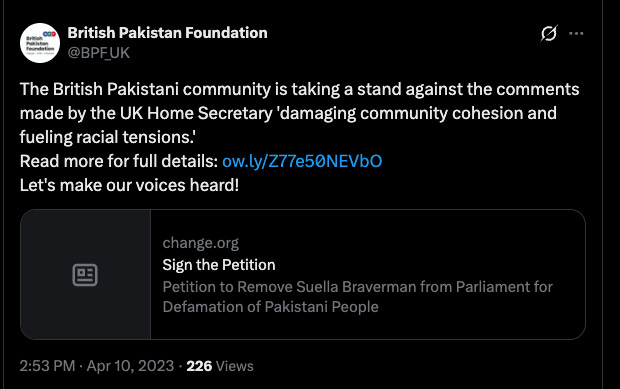
He is listed as an adviser to the British Pakistan Foundation, which criticised Braverman’s comments about what it called “so-called ‘grooming gangs’” and called for an immediate ceasefire in Gaza. The group also shared a petition calling for Suella Braverman to be removed from parliament.
Ikram is also listed as a visiting faculty member at the Pakistan College of Law and has addressed a legal conference in Lahore.
Grooming gang survivor Fiona Goddard told me: “I find Tan Ikram’s association with the British Pakistan Foundation deeply concerning as a survivor of Pakistani grooming gangs.”
She added: “To call them ‘so-called grooming gangs’ is an insult to all survivors. Why is a senior judge connected to such a partisan group?”
Goddard also called for transparency over any links between judges and such groups, questioning whether those connections could have influenced sentencing in grooming gang cases.
It can also be revealed that Ikram helped organise a meeting at the Old Bailey between judges and some of Britain’s most senior imams.
This investigation examines the record of one of the country’s most senior and influential magistrates, from his most controversial rulings and comments on race to his work with Pakistani and Muslim organisations.
The making of a diversity champion
Tanweer Ikram was born in Slough in December 1965 to Pakistani parents. According to a 2018 profile in Counsel magazine, he spent part of his early childhood in Pakistan before returning to Britain, where he had to “re-integrate during his primary school years”.
“My parents came to England in the early 1960s and neither of them went to school. I was born in Slough, but my Mum today doesn’t really speak English so I kind of felt like an outsider,” Ikram said in an interview with UK Judiciary in 2021.
In the 1980s, he attended Wolverhampton Polytechnic, initially studying engineering before switching to law and graduating with a 2:2. He worked selling mobile phones before entering the legal profession.
He was called to the Bar in 1990, having had to resit his Bar exams, and was admitted as a solicitor in 1993.
Reflecting on his early career in his interview with UK Judiciary, Ikram said he “didn’t see many Asian lawyers of my background” when he joined his law firm, but had used his ethnicity as “a bit of an advantage”.
“Sometimes difference can actually work in your favour,” he said.
Ikram became a part-time judge in 2003 and was appointed Deputy Lead Diversity and Community Relations Judge the following year, a role in which he leads 150 judges involved in pushing diversity.
He went on to become a full-time district judge in 2009 and deputy chief magistrate in 2017, and has also served on the judiciary’s Diversity Committee.
Elsewhere in the 2021 interview, he said: “The first misconception is, who are the judges? We’re not all white, we’re not all old men.” Ikram emphasised that progress on ethnic diversity within the judiciary had been slower than he would have liked.
Addressing the Association of Muslim Lawyers in 2021, he described attending meetings about how to “hasten the diversity of our judges”.
Controversial judgements
On 25 September, Ikram refused bail to Daniel Thomas, known as Danny Tommo, at Basingstoke Magistrates’ Court. The Patriot Platform founder has pleaded not guilty to criminal damage following an allegation that he slashed a small boat in the English Channel while an emergency responder was aboard. He also denies failing to disclose his phone’s PIN number to the police.
Ikram said he was “satisfied there is a real possibility of an immediate custodial sentence in this case”. On 29 September, a different judge also refused Thomas bail at Portsmouth Crown Court. His trial is scheduled for March 2027.
Ikram has presided over a succession of controversial cases involving pro-Palestinian demonstrators, the woman who attacked Nigel Farage and police officers prosecuted over racist messages.
In February 2024, he gave three women convicted of a terrorism offence 12-month conditional discharges, allowing them to walk away without a fine or prison sentence. They had displayed paraglider images at a pro-Palestine protest just a week after Hamas used paragliders in its deadly attack on Israel.
“You crossed the line, but it would have been fair to say that emotions ran very high on this issue,” Ikram told them. He said he had “decided not to punish” the defendants.
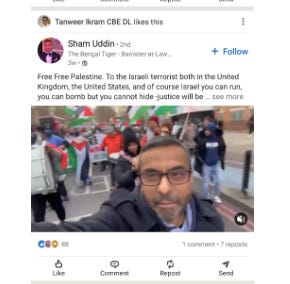
Shortly afterwards, it emerged that Ikram’s LinkedIn account had liked an inflammatory pro-Palestinian post. The episode led to a formal misconduct warning in June 2024.
Ikram said the like was accidental and described the post as “repulsive”. The investigating judge accepted that explanation, finding that it had been neither deliberate nor careless.
However, he had breached social media guidance by identifying himself as a judge on the platform. The Lord Chancellor and Lady Chief Justice concluded that his actions had caused significant reputational damage to the judiciary.
Three years earlier, Ikram had warned Muslim lawyers about precisely the reputational risks of social media.
“How embarrassing would it be if you were a judge and you’d said something very, very silly and inappropriate on social media?” he asked in a February 2021 discussion with the Association of Muslim Lawyers.
He said that posting inappropriate material could call into question whether an applicant had the temperament to sit in judgement on others.
In December 2024, Ikram gave Victoria Thomas Bowen a 13-week suspended prison sentence after she pleaded guilty to assault by beating and criminal damage for throwing a milkshake over Nigel Farage during the general election campaign.
“We now live in a country where you can assault a Member of Parliament and not go to prison. The latest example of two-tier justice,” Farage said following Ikram’s ruling.
In August 2023, Ikram acquitted trans activist Sarah Jane Baker of intentionally encouraging an offence after Baker told a rally: “If you see a TERF, punch them in the fucking face.”
Ikram said it was possible Baker had been seeking attention and publicity without intending anyone to act on the words.
In June 2022, Ikram jailed former police officer James Watts for 20 weeks after he shared racist memes in a private WhatsApp group, including an image mocking George Floyd’s death.
The following year, Ikram described the case to an American audience.
“This was a police officer bringing the police service into disrepute. So I gave him a long prison sentence. The police were horrified by that,” he said, according to the College of DuPage’s student newspaper.
Lord Wolfson KC, a former justice minister, subsequently questioned whether Ikram had breached judicial conduct rules by publicly discussing a case he had personally overseen.
In May 2024, Ikram convicted Metropolitan Police officer Perry Lathwood of assault following his arrest of a black woman during a bus-ticket inspection. He subsequently fined him £1,500. He ruled that Lathwood had “crossed the line and got it wrong”, despite accepting he had not acted in bad faith.
Four months later, Southwark Crown Court overturned the conviction. Metropolitan Police Federation chairman Rick Prior condemned Ikram’s original ruling as “erroneous and perverse”.
During the same 2023 visit to the College of DuPage in Illinois, Ikram also spoke about race and policing in Britain.
“Why am I here? Well, you started it,” he told the audience, referring to the protests following George Floyd’s death, according to the college’s newspaper.
He also discussed racial disparities in police stop and search and the possibility of unconscious bias among judges.
At an earlier appearance at the college in 2018, Ikram cited Labour MP David Lammy’s review into racial disparities in the criminal justice system, questioning the disproportionate number of ethnic minority prisoners.
“Why is it that a country which prides itself on diversity, equality and justice has so many people of colour languishing in prisons?” he asked, according to a contemporary report.
“We don’t reflect the face of the society that we serve,” he said. “Those people who are exercising power over us are not us.”
Shaping the judicial rule book
Ikram’s influence has also extended to the guidance judges use in court.
He received a CBE “for services to judicial diversity” in 2022, under Boris Johnson’s government. The following year, the Conservative government appointed him to the Judicial Appointments Commission, the body responsible for selecting candidates for judicial office.
Since at least 2019, Ikram has served on the editorial panel of the Equal Treatment Bench Book, which provides guidance to judges on race, religion, cultural differences and other matters. A judicial publication that year named him as one of five panel members responsible for reviewing and updating the guidance.
The July 2024 edition, updated in February 2026, instructs judges to explore any “cultural way of thinking or mode of behaviour”, even when it has not been raised by a party’s legal representative. Ikram is credited as a contributor in the July 2024 edition, although his name does not appear in the February 2026 update.
A section on “saving face”, particularly in East Asian cultures, advises judges against simply asking, “Do you understand?”, as individuals may say yes to avoid embarrassing the judge. It also recommends that judges “soften any negative or critical comments if possible”.
